
The Science of Atmospheric Risk.
At Monsoon Metrics Labs, research is not a supplementary service—it is the bedrock of our existence. We translate chaotic environmental variables into high-fidelity climate analytics through a rigorous, repeatable scientific framework designed for the specific volatility of Southeast Asian weather patterns.
Explore our specific climate solutions →Our Triple-Pass Verification Framework
Raw Ingestion & QC
We source weather data from the Global Telecommunication System (GTS) and proprietary local sensor networks in Bangkok. Our first pass cleans multi-source noise, ensuring temporal consistency across disparate datasets.
Dynamical Downscaling
Generic global models lack the resolution for urban micro-climates. We apply risk modeling that downscales global projections to 1km grids, capturing specific heat-island intensities and drainage bottlenecks.
Peer-Level Calibration
Every model output is cross-referenced against 30 years of historical precipitation benchmarks. This ensures our climate analytics do not suffer from the "drift" common in uncalibrated machine learning models.
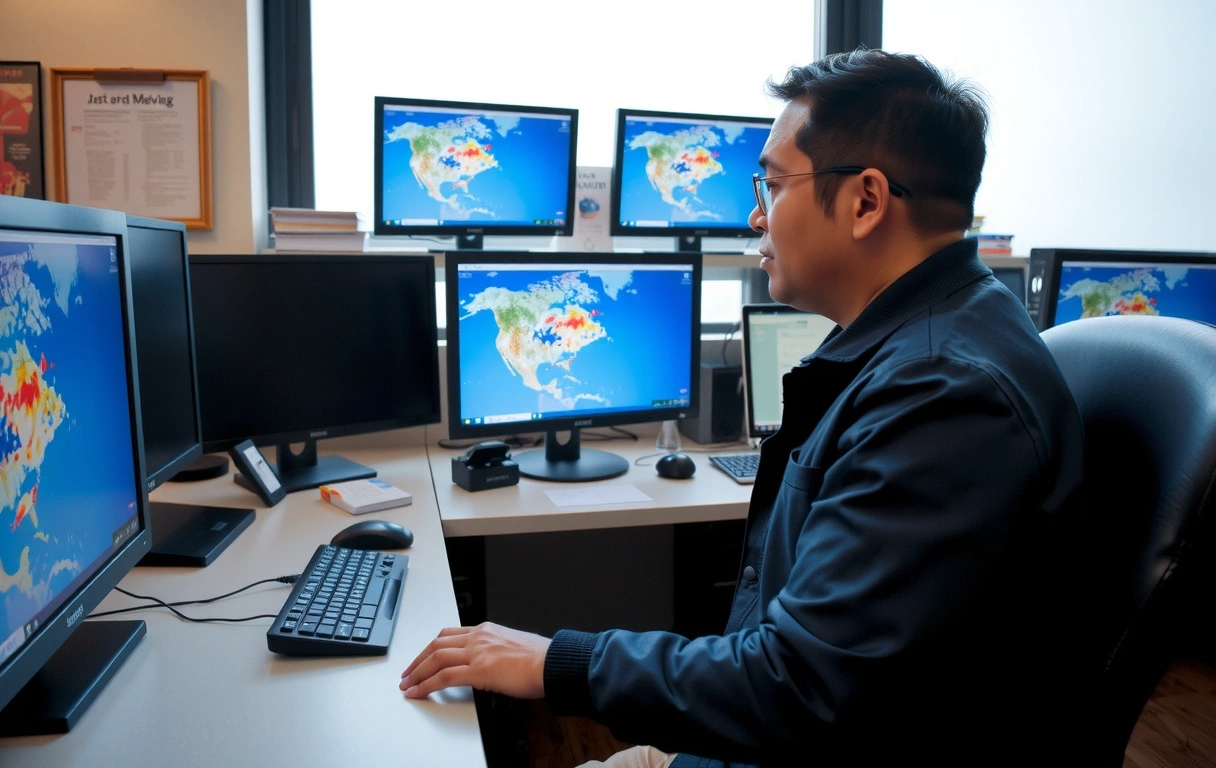
Internal Facility Alpha
"Our Bangkok-based compute cluster processes over 4TB of atmospheric pressure data daily, sourcing directly from oceanic sensors and orbital telemetry."
Validation in the Field
We do not rely solely on remote sensing. Monsoon Metrics Labs maintains a network of ground-truth humidity and barometric stations across key industrial zones in Thailand.
This hybrid approach—combining orbital surveillance with terrestrial sensor hardware—allows us to provide risk modeling that reflects the actual physical constraints of our clients' physical assets, rather than theoretical averages.
Scientific Standard Calibration
Global climate models are sufficient for local site-specific development planning.
Global models often miss convective precipitation events common in the tropics, leading to a 40% underestimation of flash flood risks.
Recent weather extremes are "black swan" events that cannot be modeled accurately.
Through extreme value theory and non-stationary distribution analysis, we categorize these as expected outcomes within shifting baseline parameters.
Expert Methodology Leaders
Our team is comprised of PhD-level researchers in climatology, spatial data science, and civil engineering. We don't just use tools; we build them.

Dr. Arisara S.
Principal Hydro-Climatologist
Specializing in monsoon variability and urban flood dynamics with 14 years of active Southeast Asian research.

Kenji Tanaka
Lead Systems Architect
Expert in high-performance computing (HPC) for atmospheric simulation and real-time weather data streams.
Published Rigor
Our work is frequently featured in regional climate summits as the gold standard for adaptive risk reporting.
98.2%
Correlation Score
Historical back-testing accuracy against major 2021-2025 regional precipitation events.
Deep Technical Engagement
Transparency is a core tenet of Monsoon Metrics Labs. We provide stakeholders with the full documentation of our modeling assumptions and data sources.
Methodology Abstract
A 12-page breakdown of our spatial interpolation and stochastic modeling logic for heavy industry.
Inquire with Experts
Speak directly with a research lead about vertical integration for your local development projects.
Monsoon Metrics Labs
Established 2018 in Bangkok, Thailand.